
Canada’s Food Security Strategy has just been released and aims to strengthen the country’s food system through investments in local food production, supply chains, food processing, and infrastructure. These investments will help Canada respond to climate change, global instability, and future disruptions to food supply. We welcome this approach and believe it is an important step toward a stronger food system. But if we want a truly food-secure Canada, we need to recognize that producing enough food and ensuring people can afford it are not the same challenge.
Canada’s Food Security Strategy Strengthens Our Food System
At The Depot, we welcome the Government of Canada’s commitment to strengthening the country’s food systems. Investments in local food production, supply chain resilience, and food system infrastructure are important steps toward building a more self-reliant and sustainable food future.
The strategy rightly focuses on strengthening Canada’s national food security. However, it gives far less attention to an equally important dimension of food security, household food security: whether people can actually afford to access that food.
Food Insecurity Is an Income Issue
National food security is about ensuring Canada can produce, process, and distribute enough food to withstand climate disruptions, economic uncertainty, and geopolitical instability. Household food security concerns whether or not people have the income they need to access nourishing food. Both are essential, and strengthening one does not automatically solve the other.
Across Canada, household food insecurity continues to rise. Here in Montreal, one in five people experience food insecurity, not because there isn’t enough food, but because too many households cannot afford it.
For decades, research has consistently shown that household food insecurity in Canada is ultimately an issue of food affordability and income, not food supply. As housing costs continue to rise, wages fail to keep pace with the cost of living, employment becomes increasingly precarious, and income supports remain insufficient; too many households are forced to make impossible choices between food and other essential expenses.
That is why a food security strategy in Canada needs to include a clear and measurable plan to reduce household food insecurity.
Building a Stronger Food System Also Means Improving Food Access
As the federal government implements Canada’s Food Security Strategy, we encourage policymakers to match investments in a stronger food system with meaningful action to reduce household food insecurity. This means setting a national target to reduce food insecurity, ensuring income supports keep pace with the real cost of living, and investing in community initiatives that improve access to nourishing food while strengthening local food systems.
It also means tackling the factors that drive up the cost of food. That includes promoting fair competition in the food system and making sure farmers, food producers, and food system workers are fairly compensated and can work in safe conditions.
A resilient food system and adequate income security are not competing priorities. They are complementary investments, and both are necessary if we want to meaningfully reduce food insecurity in Canada.
Local Solutions Show What’s Possible
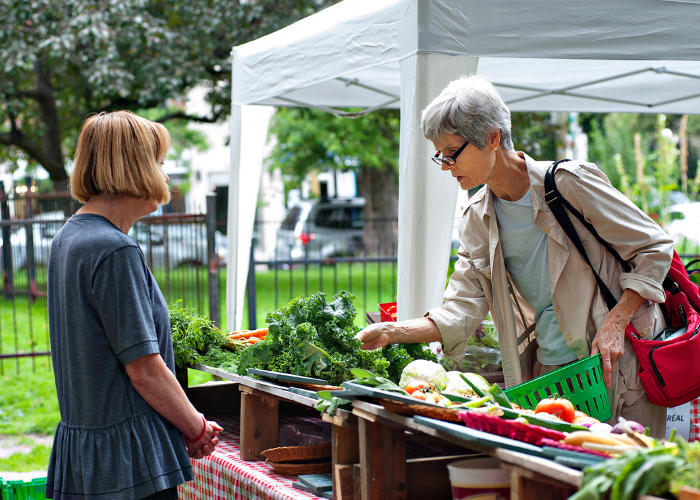
Programs like Carte proximité demonstrate what is possible when food access and local food systems are strengthened together. By helping households purchase fresh, local, and culturally relevant food at a growing number of markets across Montreal, including our Good Food Markets, this food coupon model increases access to nourishing food while supporting regional producers and community-based food networks.
Reducing food insecurity is not only about helping people afford food today. It is also about building a food system that is sustainable, more resilient, more diverse, and more equitable for the future.
We can do two things at once. And we must. Governments have an important role to play in creating the conditions for a healthier, more food-secure future by ensuring that policies across all sectors support both resilient food systems and people’s ability to access nourishing food.
A food system can only be considered secure when everyone has access to nourishing food with dignity.