On World Food Day, a coalition of community organizations is calling on the new government to make the right to food a priority.
This year, the theme for World Food Day is ‘Innovation today. Nourish tomorrow.’
When we talk about food innovation, we tend to think of vertical farms, apps designed to reduce food waste, or lab-grown proteins. We’re proposing something different: in Quebec, one of the most ambitious food innovations could take the form of a law. A collective commitment to recognizing adequate food not as an aspiration, but as a fundamental right — and to ensuring that governments take the necessary steps to progressively realize it.
This vision is gaining momentum through a growing movement. Last April, nearly 400 people from the community, agricultural, business, academic and institutional sectors came together for the first National Summit on the Right to Food, an initiative led by the Regroupement des cuisines collectives du Québec.
Today, we’re adding our voices to this growing call: it’s time to make the right to food a reality in Quebec.
A food system that produces plenty, but doesn’t feed everyone
The paradox is striking. Quebec produces food and our supermarkets are well-stocked. Yet, according to a 2025 Léger survey, 36% of Quebecers experience some form of food insecurity. Among those aged 18 to 34, that figure rises to 49%. And 41% of people experiencing food insecurity are employed.
In Quebec, having a job is no longer a guarantee that you can afford to eat well.
When the lines keep growing
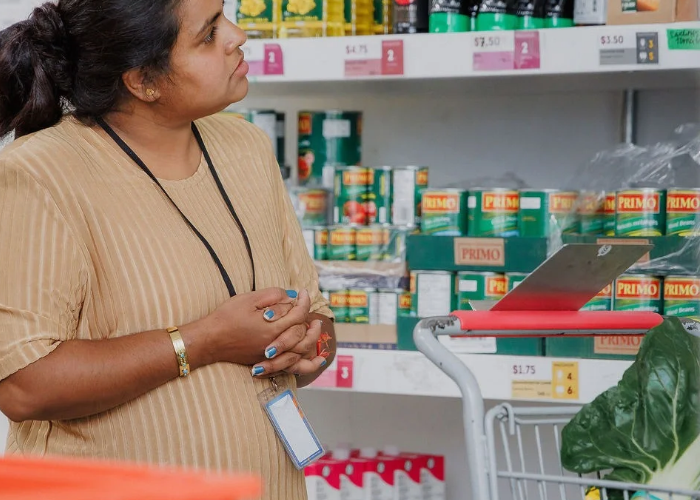
At The Depot, as at many of the organizations signing this letter, we see the realities behind these numbers every day. We distribute food baskets, serve meals, and run cooking workshops, community gardens and markets that help thousands of people access nourishing food, exercise choice, participate in their communities and build meaningful relationships.
Community organizations are constantly finding new ways to respond. But too often, that capacity for innovation is being stretched simply to keep up with growing demand.
When the lines keep getting longer year after year, despite everything we’re doing, the question is no longer, “How can we do more?” Instead it’s: Why do so many people need help just to put food on the table?
Community generosity and philanthropy are essential, but they cannot, on their own, address the structural causes of food insecurity.
A right recognized in 1976, still far from guaranteed
In 1976, Canada endorsed the International Covenant on Economic, Social and Cultural Rights, recognizing the right to adequate food. Fifty years later, that right remains far from being realized.
Over the decades, we’ve developed a range of responses: emergency food assistance, income supports, school meal programs, food coupons and local agriculture initiatives. Each plays an important role, but too often, these efforts operate in isolation and depend on shifting government budget priorities.
We cannot address food insecurity without addressing income insecurity. When people’s incomes are not enough to cover basic necessities, improving food availability or affordability alone will not solve the problem.
From recognition to action
That’s why we’re calling for a framework law on the right to food.
Such a law would establish a lasting legal foundation for the right to food, set clear targets for reducing food insecurity, and support coordinated action across government ministries. After all, food insecurity cannot be addressed in isolation. It is deeply connected to health, income, education, housing, agriculture, the environment and regional development.
A framework law would not merely be a mechanism for accountability. It would also help governments coordinate policies, sustain progress beyond annual budget cycles, and pursue ambitious, long-term solutions.
For the new government, this is an opportunity to leave a meaningful legacy: putting in place the conditions that allow more Quebecers to access the food they need, with dignity and choice.
A law would not fill people’s fridges overnight. But it could help move us beyond fragmented, short-term responses toward a coherent and lasting public commitment to the right to food.
Innovate today to nourish tomorrow
The new government has four years ahead to make the right to food a collective priority.
Tomorrow morning, we’ll be there, as always, supporting the people who turn to our organizations. But our collective ambition cannot stop at finding better ways to manage an ever-growing need.
We can build a Quebec where everyone has access to adequate, nourishing and culturally diverse food, with dignity and choice.
The innovation Quebec needs isn’t just about how we produce food. It’s about how we ensure everyone can access it.
A framework law on the right to food would be a concrete step toward that future.
Jennifer Brennan & Marguerite Kinfack, Co-Executive Directors at The Depot Community Food Centre
Amanda Ventrudo, Coordinator at Corbeille de pain
Anne Marie Aubert, Coordinator at Conseil du Système alimentaire montréalais
Camille Perry, Coordonnator at la Table de concertation en sécurité alimentaire Gaspésie-Îles-de-la-Madeleine
Christa Smith, Director of Innovation Jeunes
Dana Flynn, Executive Director of Au-delà des repas
Dominique Cadieux, Executive director of Bouffe laurentienne
Florence Roy-Allard & Laurence Deschamps-Léger, Co-Coordinators of Alliance québécoise pour des systèmes alimentaires territoriaux
François Pays, Executive Director of la Table de concertation sur la faim et le développement social de l’Outaouais
Jessica Dufresne, Project lead for Droit à l’alimentation – Regroupement des cuisines collectives du Québec
Lizzie Slattery, Co-Executive Director of le Carrefour solidaire Centre communautaire d’alimentation